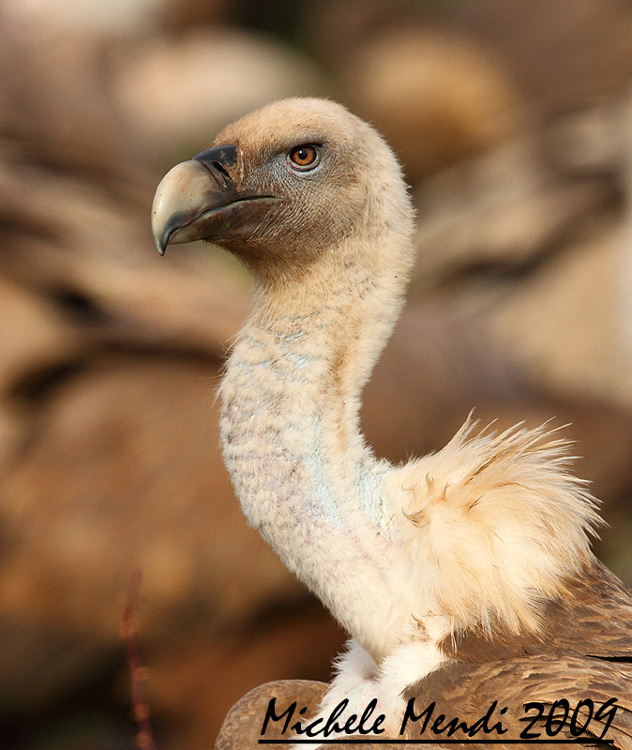
Identity card
Wingspan: 240-280 cm
Plumage (adults): Reddish brown with black feather tips, light-coloured head and neck
Flight silhouette: When flying, griffon vultures look like large rectangles, with long and wide wings and little protruding head and tail
Environment: Open areas with rocky cliffs
Nest: Holes or ledges in rocky cliffs, seldom on trees
Diet: carrion
Eggs: 1
Presence: Sedentary, juveniles tend to disperse
Distribution and status
Griffon vultures are very widely distributed, ranging from the Iberian peninsula to the Balkans, northern Africa, Saudi Arabia, Russia and India.
The largest European populations are in Spain (17.300-18.100 pairs) and France (589-639 pairs).
The historical range of this species in Italy included the Alps, the Apennines, Sicily and Sardinia, but it progressively became extinct everywhere except for Sardinia.
Griffon vultures currently occur in Italy only thanks to reintroduction and repopulation projects. The estimated population consists of 378-468 birds and about 110 breeding pairs.
In Sardinia, the species was widespread until the 1960s, with over 1,000-1,400 birds; today, about 30 pairs survive in the north-western portion of the island, where several repopulations have been carried out starting from 1974 with birds coming from Spain, which compensated for losses caused by poisoning.
Reintroduction projects have been carried out in several Italian areas.
In Forgaria nel Friuli (Udine), within the Lago di Cornino Natural Reserve, 70 adults (mostly coming from Spain and Austria) have been released starting from 1992. This led to the creation of a colony of 140 birds (increasing up to 230 during the summer, thanks to birds arriving from Eastern Europe), with 35 breeding pairs.
The State Forestry Corps has successfully reintroduced the griffon vulture in the Riserva Naturale Orientata del Monte Velino, within the Sirente-Velino Regional Park (Abruzzo), where 97 birds were released between 1994 and 2002. Despite some poisoning episodes (the most substantial ones occurred in 1998 and in 2007, when 37 birds died), the population has grown: in 2014, an estimated 180 birds lived in 5 colonies, including 34 breeding pairs and 27 juveniles.
In Sicily, the species has been reintroduced in the Nebrodi Regional Park, which houses today a colony of 100 birds, including some breeding pairs on the rock needles above the village of Alcara Li Fusi (Messina).
Another reintroduction project has been carried out in Calabria, in the Pollino National Park: after a serious poisoning episode in 2005, when all the 12 birds that had been released the previous year were killed, further releases took place in the following years. This led in 2014 to the settlement of four pairs, two of them within the Park and two in nearby Appennino Lucano-Val d’Agri National Park.
Poison and other threats
Poison is one of the most serious threats to the conservation of this species. Further threats are posed by electrocution, crashes against power lines or wind farms, poaching, disturbances in nesting sites, territory anthropization, reduced food availability, also due to closure of garbage dumps and, in Spain, of muladares or vertederos, i.e. places where breeders used to dump dead animals.